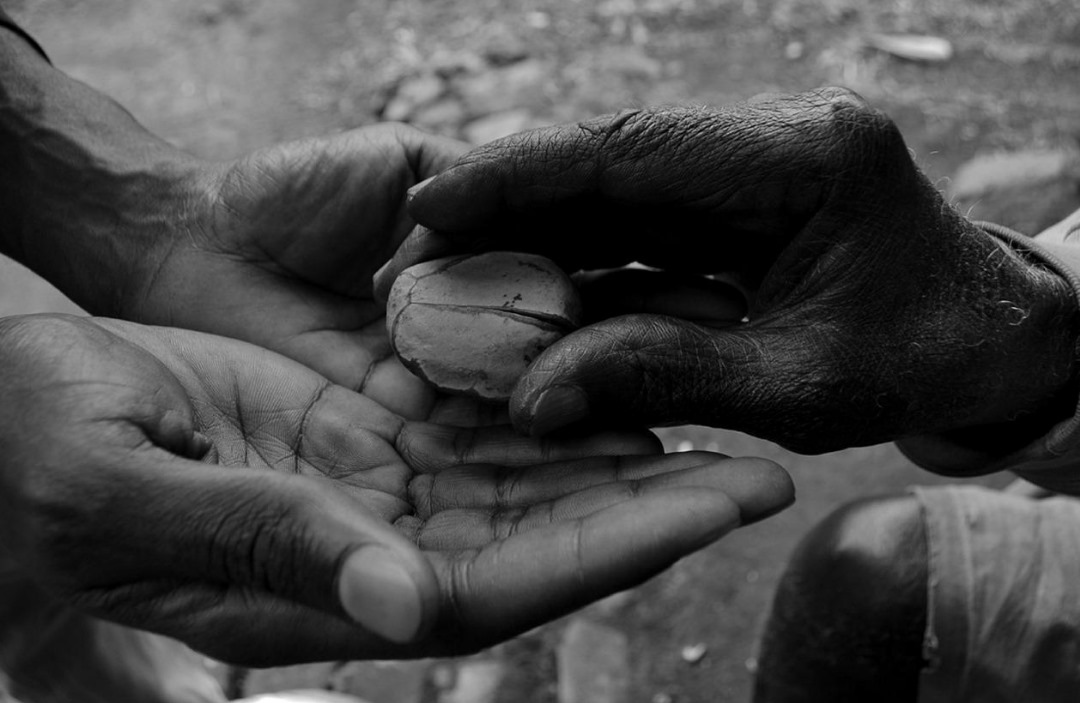
I watched my grandfather split open a kola nut with his bare hands, and for a moment, I thought it was magic. The nut cracked open effortlessly, revealing the pale lobes inside. He caught my curious stare and chuckled.
“You think it’s easy?” he asked, placing the halves in my palm. “Try it.”
I pressed my fingers into the hard shell, twisting and pulling, but it would not budge. My grandfather laughed. “Strength alone won’t open a kola nut,” he said. “You need patience.”
I had seen kola nuts many times before. At weddings, meetings, and funerals. They were always there, passed around, but I never truly understood why.
“Why do we do this?” I asked, pointing at the nut in his hands.
His smile softened, his gaze distant, as if he could see generations of ancestors standing behind me. He motioned for me to sit. “Let me tell you a story,” he said.
The kola nut, or oji, is one of the most sacred symbols in Igbo culture. It is more than just food—it is a language, a gesture of goodwill, a bridge between worlds. Whenever guests arrive, they are welcomed with kola. Before any important discussion, the nut must be broken. It is offered to the ancestors, to the spirits, and to the living.
In the old days, the oldest man in the gathering would take the kola nut, lift it to the sky, and pray. His words would call on the spirits of the land, the gods and the ancestors, and the forces of peace. If the kola nut had four or more lobes, it was considered a sign of good fortune. A nut with only two lobes was rare and carried a different meaning.
The way the kola nut is shared matters. It is broken by the oldest, passed from the host to the guests in a specific order, and eaten in silence as a mark of respect. The red variety, oji utaba, is prized for its bitterness, while the white kola, oji ugo, is a symbol of purity.
In some communities, kola nut rituals are reserved for men, but in others, women can partake in its breaking and blessing. Regardless of who handles it, kola is the key to unity. It is presented at weddings to signify the union of two families, at title-taking ceremonies to honor a man’s achievement, and at funerals to bid the dead farewell.
My grandfather told me that kola was not just for greetings, it was history, community, and identity in a single nut. Even in modern times, the tradition remains. In the city, where people no longer wear wrappers and coral beads, kola still finds its way to gatherings.
GLOSSARY:
● Oji – A caffeine-containing nut from the kola tree, widely used in West Africa for rituals, hospitality, and social gatherings.
● Oji Utaba – A red variety of kola nut, known for its bitterness and commonly used in traditional ceremonies.
● Oji Ugo – A white kola nut, symbolizing purity and good fortune, often reserved for special occasions.