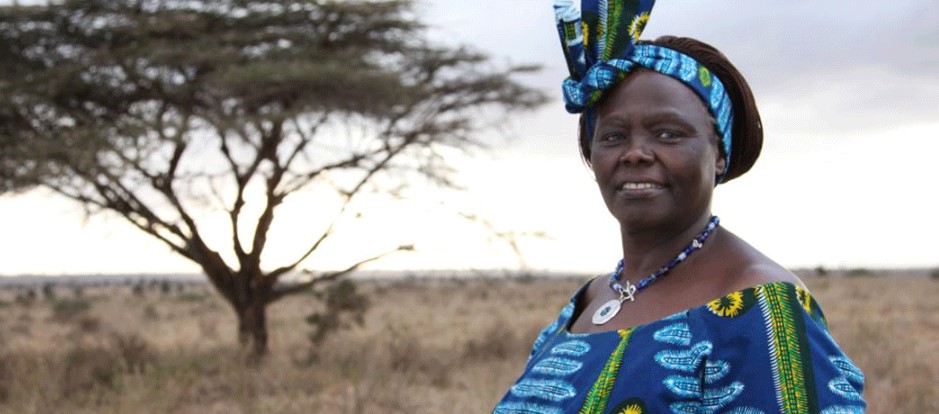
On April 1, 1940, Wangari Muta Maathai was born, in Nyeri, Kenya. She won the Nobel Peace Prize in 2004 and founded the Green Belt Movement. She was among the few African women to receive higher education at the time. She received a scholarship from the Kennedy Airlift Program in 1960 and went to the United States to complete her biological sciences degree. She went on to get a master’s degree and a doctorate, making her the fi rst woman in East and Central Africa to accomplish so.
From 1976 until 1987, Wangari Maathai was involved with the National Council of Women of Kenya, and served as its head from 1981 to 1987. She fi rst proposed the concept of planting trees with the people in 1976 while she was a member of the National Council of Women. She then went on to build it into a large, grassroots organization that focused mostly on planting trees with women groups, birthing the Green Belt Movement. Through the Green Belt Movement, she assisted women in planting more than 20 million trees.
Deforestation, soil erosion, and desertification caused serious environmental degradation in Kenya in the 1970s. Rivers dried up, the land grew less fertile, and firewood became scarcer as trees were cut down for cultivation and urbanization. Women were compelled to travel great distances in pursuit of resources, as they were frequently in charge of gathering wood and water for their families.
Wangari Maathai saw the connection between food insecurity, poverty, and gender inequality and environmental degradation. Restoring Kenya’s forests, in her opinion, could help rural communities in regaining their standard of living.
Her answer was straightforward but profound: give women the authority to plant trees in their communities, which will benefit them socially and economically while also assisting in environmental restoration.
The Right Livelihood Award was given to her in 1984 for “converting the Kenyan ecological debate into mass action for reforestation.” Wangari Maathai was elected to the Kenyan Parliament and served as President Mwai Kibaki’s assistant minister for environment and natural resources from January 2003 to November 2005. She served on the World Future Council as an Honorary Councilor.
Wangari Maathai’s tenacious fight for democracy, human rights, and environmental preservation has earned her recognition on a global scale. During special sessions of the General Assembly for the five-year review of the Earth Summit, she had spoken on behalf of women and addressed the UN on multiple occasions. She was also a member of the Commission on the Future and the Commission for Global Governance.
Professor Maathai served on the boards of several organizations including the UN Secretary General’s Advisory Board on Disarmament, The Jane Goodall Institute, Women and Environment Development Organization (WEDO), World Learning for International Development, Green Cross International, Environment Liaison Center International, the Worldwide Network of Women in Environmental Work and National Council of Women of Kenya.
In December 2002, Professor Maathai was elected to parliament with a vote of 98%. She was subsequently appointed by the president as Assistant Minister for Environment, Natural Resources, and Wildlife in Kenya’s ninth parliament.
On September 25, 2011, while undergoing treatment at a hospital in Nairobi, Wangari Maathai passed away. Her remains were cremated and buried at the Wangari Maathai Institute for Peace and Environmental Studies in Nairobi.